Surah Al-Kahf
Surah Al-Kahf is the eighteenth Surah of the glorious Quran and consists of a hundred and ten verses.
The verses of the Surah can be divided into three main sections: the introductory verses: 1–8 , the main body, elaboration in detail from verse 9–101 and the concluding verses: 102–110. In its broader sense, the central theme of the Surah is the affirmation of monotheism and the refutation of polytheism (shirk). God is one, and there is no god but Him. Reading the english transliteration has given me some insight about one of the most powerful Surah’s.
The name Surah Al-Kahf, meaning “The Cave” in Arabic, carries deep symbolic title. It was revealed during the early years of Prophet Muhammad (SAW), a time marked by fervent persecution faced by a small community of Muslims in Makkah aka Mecca. This Surah addresses themes of faith, patience, and resilience, presenting parables and stories that encourage everyone to remain steadfast in their beliefs despite hardships.
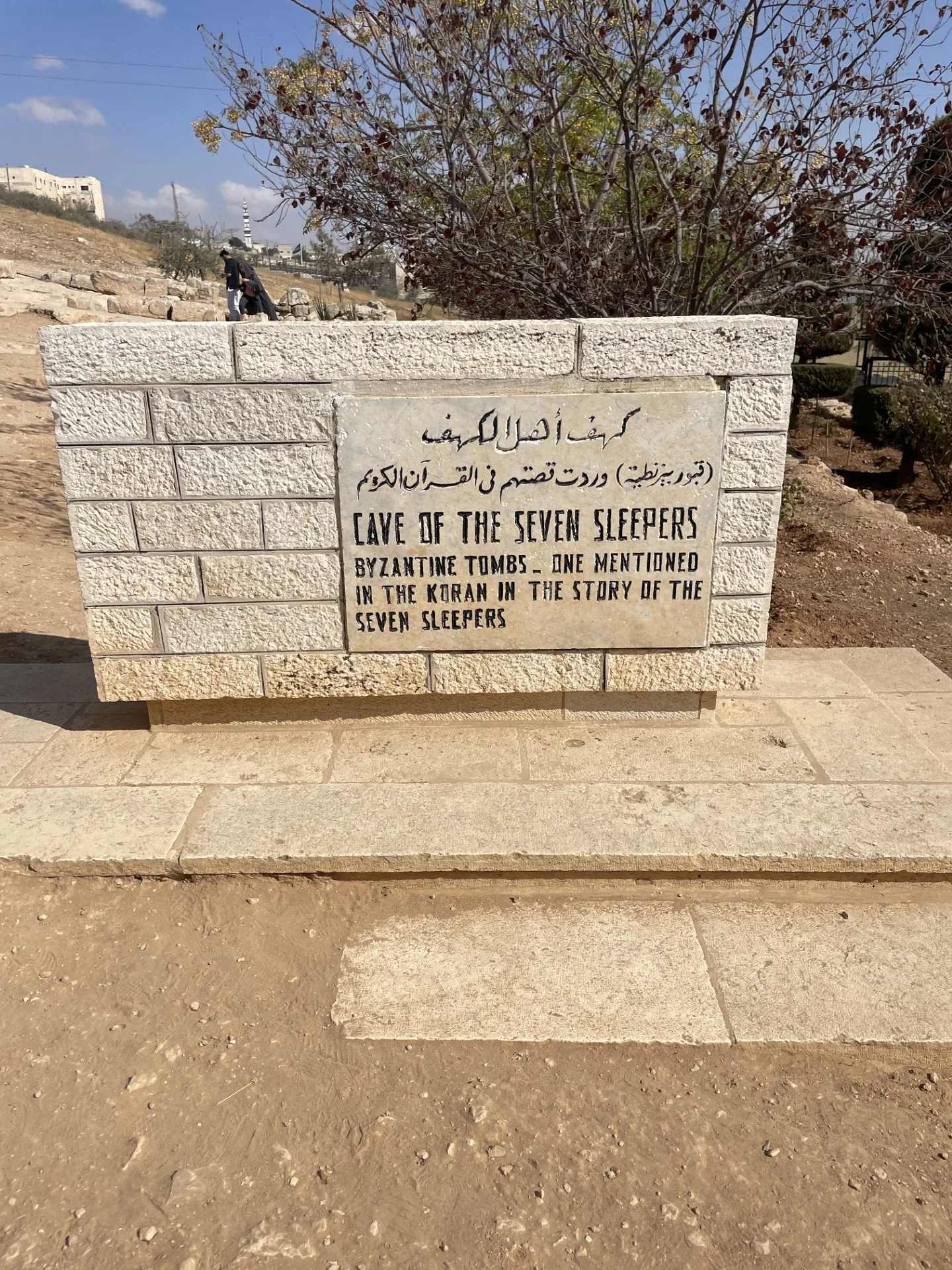
The location of the cave is in ar-Rajib, a village to the east of Amman, Jordan, some disagree and debate that it’s actually located in Turkey. The cave described is built so that the sun never enters it at any time and there is a spacious hollow area inside the cave where wind and light can easily be reached. The Qur’an, in its distinct literary style, depicts this scene as follows: "(O listener!) When you look at the sun as it rises, it moves to the right side of their cave; and when it sets, it passes to the left, while they remain inside its spacious interior." (18:17). Moreover, the use of the definite article al (meaning 'the') before kahf indicates that they had already preselected that cave. This point is very important: it means they chose the cave thoughtfully and deliberately. It was spacious inside, and its entrance was narrow (as the image below shows).
When visiting the cave located in Jordan, a maximum number of twenty people could probably fit inside at any one time. To enter the cave you have to step down two steps and you see the cave divided into three sections. In the eastern and western sections are eight constructed graves resembling coffins. On the eastern section is a grave with a small hole and if you peep into the glass hole, a corpse of some kind can be clearly seen (I only saw bones). If it is dark the attendant of the cave lights a candle and the inner view can be clearly observed.
The four parables in the surah:
1."The people of the cave"
This, most commonly known, as briefly described above is the story of young men who lived in an area surrounded by disbelievers , so they decide to migrate.
In around 250 CE a Roman king called Daqyanoos (Decius) would annually hold a gathering dedicated to the worshipping of idols. Many people would attend dressed in their best clothing. However, one youth believed in the oneness of God, the teachings of Isa (AS) and shunned against pagan worship. He rebelled against the practices that were happening in the society and formed a small group of like minded people…
When the king heard what was happening he became angry and commanded for them to be killed. In order to save their faith they fled and went into hiding. On their escape route they met a young farmer who owned a dog so they invited him into Islam and he accepted. Eventually they came to a cave and decided to take rest there for a while, leaving the dog (named Qitmir) near the entrance as a guard. Indicating it was no ordinary dog that happened to be with them, but a trained guard dog. The Quran states that the period of time these sleepers spent in the cave was 300 years during which the calendar of their people was changed from solar to lunar and, as a result, the period of their sleep was 309 years. When they woke up, they had no idea they slept for centuries and thought they had only slept a few hours. When they sent one of them to buy food, the shopkeeper was amazed to see old coins and the reality of the time they had spent in the cave gradually came to light. The present ruling king, whom some scholars have identified as Theodosius, became a believer and sought their blessings. When these young men died they were buried in the cave along with their dog. This narrative highlights staying firm in faith, prioritising Allah Ta’ala over worldly comfort, and the ultimate victory of truth over falsehood.
2. "The owner of two gardens."
A story of a man whom God blessed with two beautiful gardens, but the man forgot to thank the One who blessed him with everything and he even dared to doubt God regarding the afterlife. So his garden was destroyed and so he lived with regret. This was his trial of wealth.
God begins by introducing the incredibly rich owner of the two gardens to us. He had two grape gardens and other cultivated fields, with rivers that streamed in between, and the whole property was surrounded with date-palm trees. God made his gardens in such a way that they never failed to produce good quality fruits and crops, always fertile, and constantly brought forth maximum results. So not only were his gardens absolutely beautiful, but they always brought him maximal profits.
While the rich man spoke so highly of himself, inadvertently insulting his companion, the companion remained silent. However, the companion could not accept the man’s insult of God. The companion instead advised the rich man against being ungrateful to his Lord and reminded the rich man of his origins as of all human beings. He also declared that he would not associate any partners with His lord. This was in relation to the rich man attributing the success of his lush gardens to himself thus, making himself an idol besides God. Despite having been insulted by the rich man, the companion accepted his fate and believed that God will grant him something better. As the companion warned the rich man of God’s punishments due to the rich man’s arrogance, his gardens were destroyed. Hereby teaching us that wealth is also a test from God as He is testing the recipient of wealth on their gratitude. Secondly, we also learn that things of this world are temporary and transient. All the pleasures and riches of the world are short-lived. Therefore, when they are available, one must thank God and spend on the ones who don’t have the worldly pleasures available to them.
3. "Musa(AS) and Khidr (AS)"
When Musa (AS)was asked “Who is the most knowledgeable of the people of Earth?” Musa (AS) said that it was him as he assumed he was the only prophet on Earth at the time. But God revealed to him that there was someone who knew more than him. Musa (AS) therefore travelled looking for him and learned how divine wisdom can sometimes be hidden in matters which we perceive as bad. This was his trial of knowledge. In a nutshell there were three tests prevalent in the verse:
First test : When Musa (AS) is an infant he was put into the water and was saved by God’s protection.
Second test : When Musa (AS) killed an individual and was summoned by an opponent of 'killing a soul', before fleeing and being saved from the armies of Pharaoh. God provided him help.
Third test : When Musa (AS), after fleeing and arriving alone and helpless at Madian, helped ladies with a well to drink and/or water their sheep. He subsequently had been offered a fair deal by Shu`aib (AS) for his help.
Musa (AS) was constantly in search for the Truth his never-ending knowledge includes Two Seas of Knowledge: one is the empirical knowledge based on sensory observation and experience and the other is the spiritual knowledge based on wisdom. It clearly illustrates the difference between the people of exoteric knowledge and the people of esoteric knowledge. God asks him to meet al-Khidr (PBUH). According to the opinion of the majority of scholars, this refers to the junction between the eastern Mediterranean and the Persian Gulf.
During this return journey of revisiting his memories, Musa (AS) met the enlightened one (18:65), Khidr which literally means 'The Green One', depicting freshness of spirit and eternal liveliness, green symbolising the freshness of knowledge “drawn out of the living sources of life.” In Egyptian tradition, Osiris is depicted as a green skin god. Moldavite tektite is Green, a powerful transformation stone, the peyote cactus is also green, a powerful medicine plant that brings to to the Barzak state of mind and heart. Al-Khidar was known as one of those who received illumination direct from God without human mediation and in this Surah he tutors Musa (AS) on the mysteries of predestination and theodicy. As Khidr was “given the knowledge from the unseen” (18:65). There is a difference of opinions on whether he was a prophet and I’m still uncertain, the strongest argument for him being a prophet is this part of the ayah 82 of Al-Kahf: "[...] I did not do it of my own accord." A non-prophet wouldn't get direct orders to do the things Khidr (AS) did (specially killing someone). In all three courses of actions that he is asked, Kidhr (AS) mentions God’s intentions and future events. That's why those actions were so strange, could a non-prophet outright kill a young boy in hopes of God giving the parents a better child?
In this story, it clearly conveys the message that patience does not mean waiting longer until clarity arrives. It means remaining in confusion, moral discomfort, or cognitive dissonance long enough for a deeper intelligence to emerge. It is restraint from judging, proving and grasping at knowledge before one is ready. When patience is absent, the desire for knowledge turns into impatience, revealing not a lack of facts but unreadiness of the self. This is why the three actions are so striking. They are meant to provoke immediate resistance. Each one exposes the limit where moral instinct and learned judgment fail, hence they are not lessons in events, but tests of readiness. For this reason, I think Khidr is different for every person, not as a changing figure but as a changing encounter. What Khidr represents meets each individual at the precise limit of their understanding and character. For some it appears as injustice, for others as loss, and for others as silence where answers are expected. Khidr does not meet people where they are curious but where they are unprepared. Many narratives about Khidr and living saints seem to institutionalise something that is inherently personal and unevenly experienced. What depends on inner readiness became stories and hierarchies, often serving those who did not experience it directly. The Qur’an is clear no one carries another’s burden, and everyone comes alone on the Day of Judgment. Responsibility and realisation are individual, precedent does not replace readiness, and repetition does not produce encounter. Frameworks can point, but when they replace the experience itself, the meaning is lost. In that sense, doubt here is not rejection, but discernment. And perhaps this is where the matter truly ends. Not with explanation, nor with certainty, but with a question each must carry alone.
4. "Dhul-Qarnayne" most popularly known to in the West as Alexander the Great
God mentions the story of a great king who was given knowledge and power travelling the world helping people and spreading good vibes. He was able to overcome the problem of Yajooj-Majooj by building a massive dam with the help of people whom he could not even understand. This was his trial of having power.
Muslim scholars mostly seem to agree that Alexander couldn't be Dhul Qarnayn since historically Alexander was a polytheist while Dhul Qarnayn is a firm believer. The bigger problem is historians unanimously agree that this legend is just that, a legend, and doesn't have any historical basis. Moreover, the prominent hypothesis is that this story was created as propaganda and the prophecies are ex-eventu. Dhul Qarnain in the Quran and the Bible is the same person or persons, the possessors of two kingdoms represented by the two horns. These were the kings of Persia especially referring to Cyrus the Great and Darius the Great. Dhul Qarnain means the possessors of two horn. It can also means two generations.
Synopsis of Key Journeys:
The West: Dhul-Qarnayn travels to the furthest west, finding the sun setting in a muddy spring, where he encounters people and is given authority to either punish or treat them with kindness, choosing to establish justice.
The East: He travels to the furthest east, finding the sun rising upon individuals with little protection from it, likely a primitive, uncivilized, or nomadic group.
The Barrier (Gog and Magog): On his third journey, he reaches a place between two mountains and finds those oppressed by the chaotic tribes of Gog and Magog (Ya'juj and Ma'juj). He refuses payment, constructing a massive, impenetrable wall of iron and molten copper to separate them from the civilised people.
Dhul-Qarnayn attributes the construction of the wall to the mercy of God. The lesson in this is that a grateful servant of God, even after accomplishing a great deed, does not fall into pride. Instead, his head bows even lower in humility before God. He does not say that since he built the wall, it will last forever. Rather, he openly declares its eventual destruction, like all other things in the world. It will remain standing only as long as God's natural law permits it. After that, it will be annihilated.
The Number Two
A study of Surah al-Kahf reveals that the number two is used repeatedly, for example in the following:
1. Two groups (verse 12):
One that was inside the cave and one that was outside.
2. Two sides/flanks (verse 18).
3. Two men (verse 32).
4. Two gardens (verses 32, 33).
5. Two seas/rivers (verse 60).
6. Moses and his servant (verse 61 and others).
7. Moses and the special servant of God (verse 71 and others).
8. Two orphan boys.
9. Dhul-Qarnayn, the one with two eras or two horns.
10.Two mountains or barriers (verse 93).
11.Two mountains or barriers (verse 96).
In addition to these, the dual form is used in several places, and two things are often mentioned in juxtaposition. For those who are "inside the cave," the perception of time differs from that of those who are outside the cave. There are two realms or "rivers" of knowledge: the material and the spiritual, the physical and the metaphysical, the knowledge of the moral law and the knowledge of natural law . Reality also has two facets: an outer and an inner aspect. At the beginning of the Surah, two qualities of the Qur'an are mentioned: it is free from all kinds of apparent and conceptual fault, and it provides precise and correct guidance. The purpose of this Surah's revelation is stated to be two things: warning and giving good news . First, there is a general warning followed by a specific one. It states that neither they nor their forefathers had any knowledge of God's reality. In this way, upon closer examination, many such examples can be found throughout the Surah.
Beauty
Beauty is mentioned three times in Surah al-Kahf. As the epitome of beauty, Venus sets the standard for aesthetics and favour is sought to attain charm and allur. Before when the Kaa’ba was present, the tradition of worshipping Venus was widespread in ancient Arabia, where three hundred and sixty gods and goddesses were worshipped and were eventually destroyed. Friday was ruled by Venus and it is strongly advised to recite atleast 10 verses of this Surah on this day. It further states in the hadith:
“Whoever recites Surat al-Kahf on Friday, a light will shine for him between this Friday and the next.”
Source: al-Sunan al-Kubrá lil-Bayhaqī 5996
In fact most middle eastern countries do not work on a Friday. The first time the Qu’ran mentions the word beauty (zeena) in this Surah, is precisely with this meaning.
Indeed, We have made that which is on earth as an adornment for it, in order that We may test them as to which of them are best in deeds. (18:7)
Our first observation of this ayah is that beauty is everywhere also that beauty is a test from God. Allah follows this ayah by saying:
And indeed, We will make that which is upon it [into] a barren ground. (18:8)
In the first verse on beauty in this surah, we see two major themes:
a) Beauty is all around us- are we finding it situations where matters are not so obvious? eg when we get an insect bite or if we fall over etc
c) The beauty of this Earth is temporary. It will most definitely be taken away.
The second time we notice the word zeena used , God gives us a command:
And keep yourself patient [by being] with those who call upon their Lord in the morning and the evening, seeking His countenance. And let not your eyes pass beyond them, desiring adornments of the worldly life, and do not obey one whose heart We have made heedless of Our remembrance and who follows his desire and whose affair is ever [in] neglect. (18:28)
Here the Qu'ran is telling us to remain with those that remember God, not because they are cutting a deal with Him or petitioning for an easier life, but because they are seeking the ultimate beauty, an opportunity to see Him.
Sometimes though, it’s hard to find such friends and we fear what it means to be with people who are devoted to God. Questions such as “Will they judge me?”, “I have so many flaws”, “I don’t want them to find out about me” comes to mind. It's important to take the leap that’s required and be close to them as they, too have flaws too, the beauty of this world will always be there to taunt us and if we end up stumbling we know that those who remember God will help pick us back up.
“Wealth and children are [but] adornment of the worldly life. But the enduring good deeds are better to your Lord for reward and better for [one’s] hope.”
"Wealth and children" don't literally mean wealth and children. They are used as a metaphor for all worldly possessions that don't benefit one in the afterlife.
To conclude
The final verse of the Surah encapsulates its essential message: God is one and no one has a share in His Divinity. This narrative serves as a metaphor for the struggles of the early muslims and illustrates that divine assistance will protect and guide believers who remain true to their faith. Serving us as a reminder of God’s wisdom and the importance of trusting His plan even in times of uncertainty. This Surah should make you feel confident at times in uncertainty and to have full faith in believing that things will just work out with no proof.
The core message of Surah Al-Kahf is that God tests people in this world through various circumstances through honour, humiliation, health, illness, gain, loss, happiness, and sorrow. God tests people in either of two conditions, good or bad, to see if a person is grateful in favourable conditions and patient in adverse ones.
Thus, life presents two exams: the “test of gratitude” and the “test of patience.” When an individual is blessed with good conditions and expresses gratitude, they pass the test. If they are ungrateful, they fail. Similarly, in the test of patience, if one endures adversity patiently, they succeed; if they are impatient, they fail.
This Surah contains very profound themes. It’s exegesis and commentary cannot do it full justice. In fact it is impossible to encompass all of its secrets and mysteries, thus it concludes by reaffirming the two foundational pillars of faith: pure monotheism (tawhid) and righteous action are to be grounded in sincerity and servitude before God.