

All about Gluten…free?
Today’s “wheat,”, isn’t even wheat. The wheat products sold to you today are nothing like the wheat products produced many many years ago as there has been an increase in celiac disease over the past 40 years, and an explosion in inflammatory diseases. Gluten-free eating is no longer just a necessity for those with medical conditions it’s become a mainstream trend. Walk into any supermarket and you’ll find entire aisles dedicated to gluten-free products, often marketed alongside premium "wellness" foods. I, too, have been guilty of this as I even learnt how to say gluten free in French which is “sans gluten” thus helping me hop in and out of and the local CarreFour.
What is gluten?
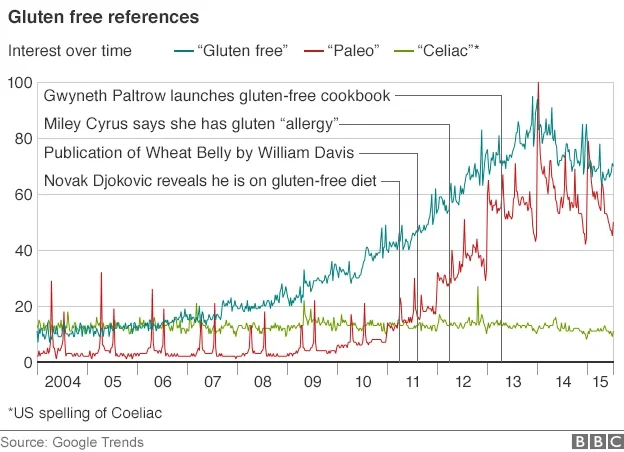
Gluten is a protein that has been present in wheat since it was first cultivated for human consumption about 10,000 years ago. A small proportion of individuals have a clear allergy to this gluten protein. The official diagnosis is “celiac disease.” And it develops just as you can develop allergies to other proteins. Many individuals seem to fall short of receiving a celiac disease diagnosis…but they still suffer from a clear “gluten” intolerance. In fact, the proportion of people with problems digesting wheat and grains with gluten has ballooned to an estimated 30 to 40 percent, or more, of the population as seen in graph B.
Celiac disease is a serious autoimmune condition, not an intolerance. When someone with celiac disease eats gluten, their immune system attacks their own tissues, specifically the lining of the small intestine.
What has changed to cause skyrocketing rates of intolerance to gluten and wheat?
Some science experts link the herbicide glyphosate to the increases in gluten sensitivity. As glyphosate blocks a key metabolic pathway that healthy bacteria navigate within the microbiome thus poisoning the healthy bacteria in the microbiome leads to a host of problems, including systemic illness, GI upset, malnourishment, and fatigue. You may have even experienced the same symptoms whilst eating gluten free oats as some may contain trace amounts of glyphosate…So, when doctors tell everyone that they don’t test positive for an official medical diagnosis of celiac disease, they may be right. If you test negative for celiac, but still experience intolerance when you consume wheat or grains, you may actually be suffering from pesticide poisoning. Ultimately, though, it’s the same problem as crops like wheat and corn are genetically modified to withstand glyphosate, which kills everything else in sight. According to one account, farmers have been known to spray glyphosate a second time, directly onto wheat and sugar cane crops to dry them out, just prior to harvesting them. (It makes the grain lighter, easier to harvest and store, and resistant to moulds.) Of course, these ingredients are featured prominently in packaged foods such as breads, cakes, cereals, and cookies. We now know that these packaged foods contain ingredients with a double dose of the toxic herbicide. Other studies have found alarmingly high levels of pesticides in these packaged goods. The worst of it is, there’s nothing you can do about these packaged poisons except avoid them. You can remove those junk food, refiner sugar, refined flours and so on, as a great solution to reduce inflammation and probably reduce or eliminate gluten sensitivity. But what if that alone does not work?
Is there a metaphysical reasoning?
In metaphysical beliefs, wheat and gluten are often symbolically tied to the concept of family structure and the paternal archetype. It is viewed as an alchemical synthesis of the four classical elements, earth (grain), water (add to flour), air (yeast/fermentation) and fire (oven heat). Whilst science views gluten intolerance and celiac disease strictly as genetic and autoimmune responses, alternative wellness philosophies link gut issues to emotional boundaries and authority figures.
This is because bread holds the family as gluten acts as a sticky glue and giving it up represents releasing rigid attachments, family patterns, or societal expectations that can keep one "stuck" . Gluten in Latin translates directly to "glue" or "cement". It is said that tearing the bread instead of cutting it is better because it signifies reciprocal love and connection toward the divine and neighbours. So the foods we eat mirror our relationship with life and authority. Wheat is a "staff of life" and a foundational nourishment, symbolically, the father figure often represents structure, rules, and grounding in the material world. As a result intolerance to wheat can be interpreted as a subconscious rejection of paternal expectations, traditional family rules, or ancestral pressure. The small intestine digests and assimilates what is useful whilst discarding the toxic.
A gut that attacks gluten is viewed as a physical manifestation of an inability to "digest" or accept a harsh environment, a rigid upbringing, or conflict with a dominant figure.
In religion, bread does not carry the same spiritual weight as it does for Christians and Jews. However, in Islam it is regarded as a blessing from Allah (swt) , and it is an important symbol of alms-giving, promoting the family as the core block of society. Special breads are a part of Eid-al-Fitr. Prophet Muhammad (PBUH) advised, “Respect bread, for it is from the blessings of the heaven and the earth.” similarly Jesus (PBUH) taught his disciples to pray for “our daily bread”. One orthodox sect of Judaism considers bread as a metonymy for humankind’s ego and self-aggrandisement. Therefore, abstaining from bread is an exercise in humility which is why it is not eaten during Passover. In Christianity the Communion loses the symbolic depth of its material makeup when taken using gluten-free bread. Just as the physicality of the bread and can draw a community together, it can work powerfully to divide as well. To keep those who cannot eat gluten limits them from participating fully in life. I do wonder how things have changed in churches…
In cinema, the Disney film Aladdin, there is a scene of him snatching a single loaf of bread just to survive, in Goodfellas, the mobsters share fresh bread in prison. In fact a kitchen scene can reveal more about a character than any monologue. Its presence on a table symbolises sufficiency; its absence signals scarcity or poverty, the act of breaking it together signals trust and shared belonging in ways that cut across cultural boundaries.
So is gluten intolerance reversible?
Well the ability to get back to gluten depends on what’s causing your sensitivity, quite literally it could be a job you hate, a close one giving you incredible stress, toxic family members, whatever it may be will assist in strengthen your gut. You being an empath could also possibly be the cause. How is your relationship with your family? If it's celiac, the gene could switch on at any time, often (but not always) triggered by some kind of stressful event. While some people are genetically predisposed to have issues with gluten, those genes may remain "silent" for decades then "trigger" the onset of gluten intolerance in adulthood. Even intense emotional stress, can impact the integrity of the gut lining and the function of the immune system. Healing the root emotional cause will assist. As celiac disease is viewed symbolically an auto immune disease this directly links to attack ones self and a literal reflection of inner conflict, deep-seated guilt, repressed anger or a lifelong habit of setting one's own needs. This outward harmony is maintained at the cost of inner peace. Having an autoimmune disease is like having having a bucket in your body with a few drain holes in the bottom. When you put water into a bucket with drain holes, as long as you don't overload it, the water can drain out slowly. But when you overload the bucket and put in too much at once, you spill over everywhere...that's the inflammatory response we experience from too many triggers. The key is to try to manage all the different triggers and avoid that overflow. The triggers come from a multitude of places. Based on your own unique genetic makeup, living conditions, personal health and daily life, those triggers can come in the form (individually or in combination) of sleep quality, stress management, exercise type and amount, exposure to (toxic and non-toxic) chemicals (this can be in anything from household cleaners to the lotion, soap and shampoo you use) food, medications like antibiotics etc.
The correlation between gluten and spending time with family
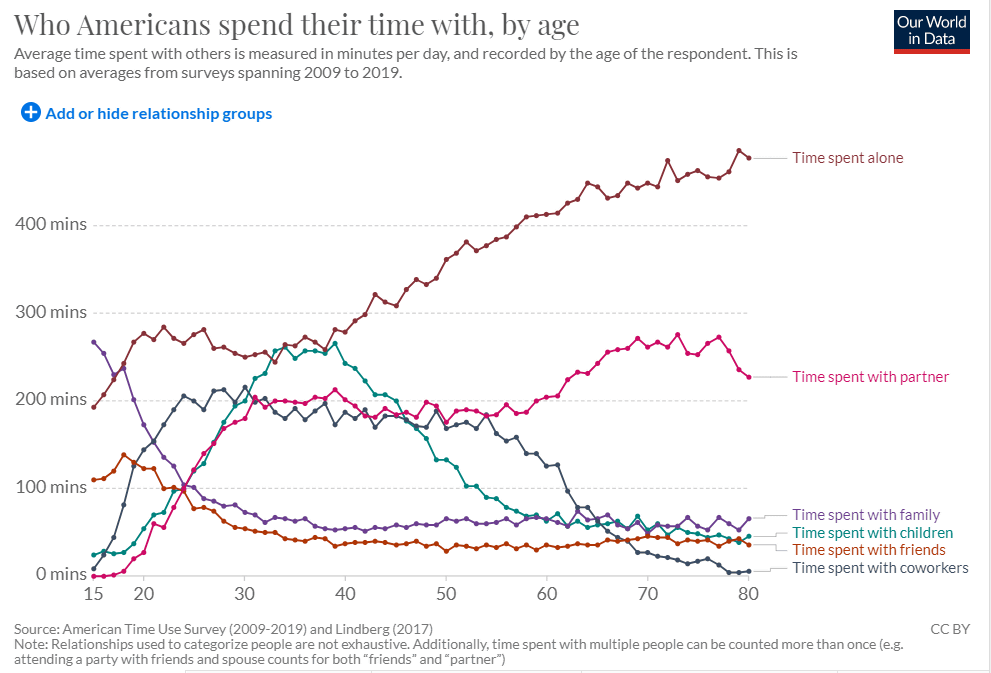
Data scientist Henrik Lindberg analysed data from 2003 to 2015 to determine how much time people spent in the company of others. He analysed the data from the American Time Use Survey, an annual census by the US Bureau of Labour Statistics as shown below:
Graph A
I must add that this survey was conducted in the US, which means that wheat intolerance is higher than Europe because there are looser regulations as to how soon before harvest wheat and other crops can be doused with herbicides.
He found that hours spent in the company of children, friends, and extended family members all plateaued by our mid-50s. And from the age of 40 until death, we spend an ever-increasing amount of time alone. It also seemed that the number of hours spent on relationships was less important than the quality of the relationship itself. This made sense as I would describe myself who is very self sufficient and independent however I have had to kick start my body a few times to achieve optimum health. I know relatives who have no issues with gluten and remain to have nourishing parents, there is no need to introduce “gluten free” foods to them as this is foreign to them.
With that being said I then decided to research how an interest of being gluten free over the years:
Graph B
The data suggests that there is a clear correlation between the amount of time individuals spend with their families and having a gluten intolerance. This shows that perhaps healing your relationship with your family may help ease symptoms associated with gluten intolerance. As someone who loves solitude there is no more "healing" to do, it may help to speak up more so that you feel calm and grounded. Intellectualising emotions and pushing feelings into logic keeps them trapped inside the body and constant chasing approval and needing to be the “good daughter/son” will do more harm than good.
Final Thoughts…
Whatever the answer, we keep asking the question. Because it’s the question itself that matters. It’s the question that challenges us to think about our daily ritual, our daily bread. Is our relationship with bread creative or destructive? Does it separate us or bring us together? And when we break our bread, with whom do we break it? Is it possible that a significant portion of us have always been mildly intolerant, but that up to this point we have had "bigger" issues to worry about? Gluten intolerance rose in stats because of a combo of heightened survival percentage, a rise in amount because of modern processes goods, and the availability, this ability to have a diagnosis and not just be "that person that is kinda ill".
There's a balance between the welfare of believers and tradition that has to be reached. There is an emphasis that one must see disease and autoimmune responses not only from the physical viewpoint, but also understand the energetic, emotional and spiritual aspects. The body isn’t only reacting to pathogens or genes, but also to “invisible” pressures. The unhealed emotions, suppressed feelings, beliefs, life stressors, past life issues, or spiritual disconnection. The idea is that unless those underlying non-physical contributors are addressed, symptoms may persist or reoccur. Processing emotions instead of spiritually bypassing them. These unglamorous fundamentals create the stability that allows deeper practices to actually work. Without them, you’re building a cathedral on quicksand.